Perspectives

The future of software is lovable


2025 has been a year that drove us to new AI peaks. On the back of rapid technological progress, incredible talent building in the AI space, and unprecedented investment in the field, expectations for 2026 are high. So what do we at Visionaries anticipate?
AI adoption
2025 gave us an early insight into AI adoption patterns. We’re seeing some industries adopt more quickly than others, with the typically slow-moving healthcare industry being a surprising frontrunner that’s already bringing the benefits of AI to doctors and patients. Some functions like sales, marketing and software engineering are leaders whereas it appears functions like HR and manufacturing are laggards.
While two thirds of enterprises have not yet begun scaling AI, the curiosity in the technology remains unprecedented. Adoption differs based on company maturity: broadly speaking, daily active usage in startups matches up to weekly active usage in scale ups, and monthly active usage in established corporations. Despite concerns about its innovation sluggishness, Germany ranks as OpenAI’s third largest market by paying AI subscribers.
As we all gain a clearer understanding of AI’s capabilities and how humans can best work alongside these tools, 2026 will see the dust continue to settle on what some enterprises call “pilot purgatory”, with more agentic use cases going live in production and the AI stack around key functions and workflows starting to solidify. We’ll better understand which products and teams can rise to the top of buying lists, and which prosumer tools can sustain real, sticky usage beyond the initial hype.

The most cited graph in AI research this year has been Metr’s overview of task duration. By measuring how long AI can complete long tasks while maintaining roughly a 50 percent success rate, it offers a simple proxy for how capable they are. The longer models can reason and work through tasks, the more powerful they become, to the point where they can start contributing to their own improvement by automating parts of AI research.
Task length has been rising exponentially, and while no one can assume that trend will continue indefinitely, it reflects what we have observed so far. At the end of 2024, there was significant debate around whether AI scaling laws were plateauing, with some predicting that increases in compute, model size and data would no longer translate into meaningful jumps in model performance.
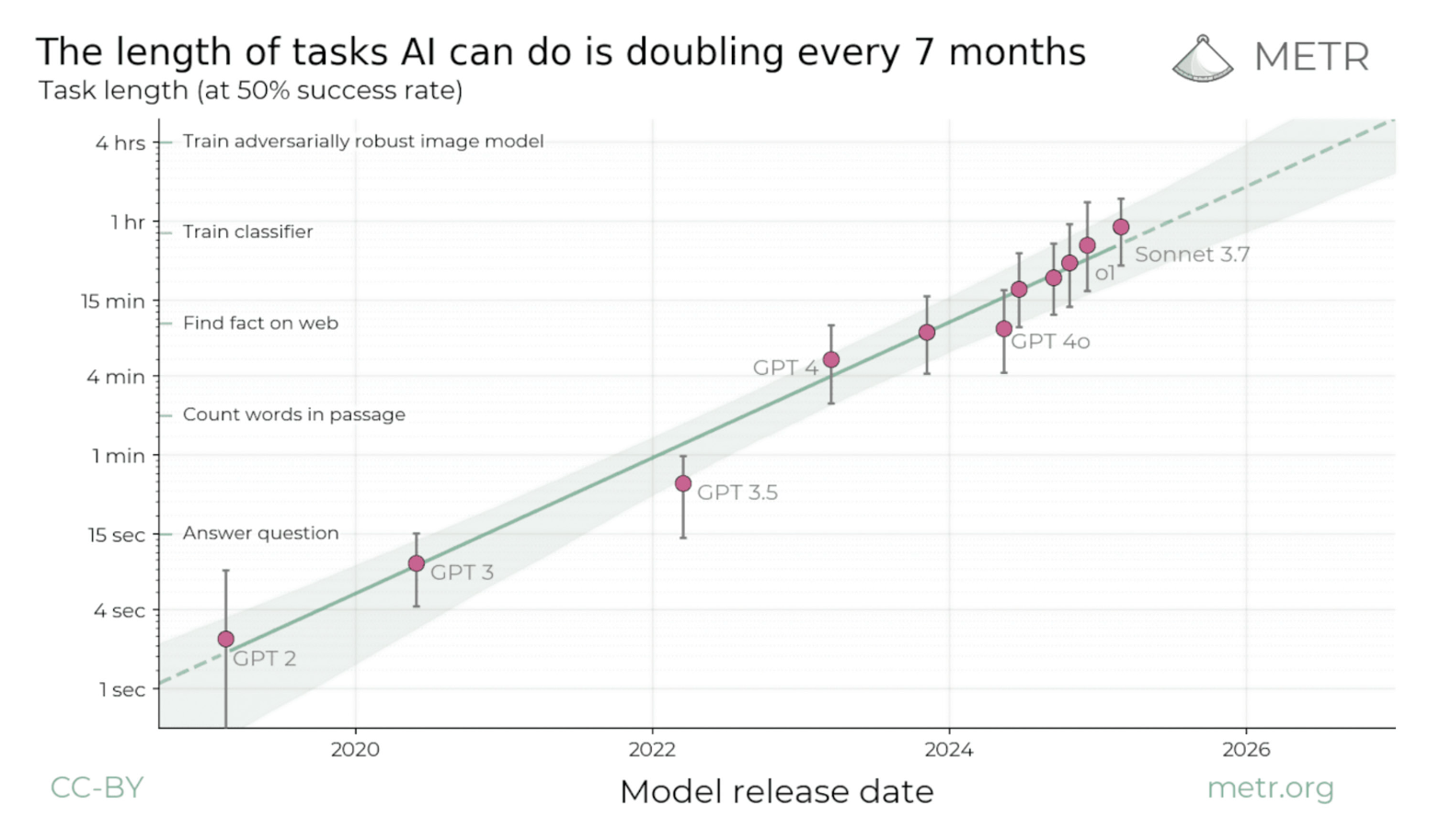
Metr’s overview of AI task duration
After feeding the entirety of the public internet into LLMs and experimenting with new ways to generate data, whether through human labelling or synthetic creation, we find ourselves discussing the same concerns a year on. Broadly speaking, AGI timelines drifted outwards over the course of 2025, starting on a bullish note and short time spans in the beginning of the year, with something of a consensus forming around the idea that AGI is still a decade away on the back of narrower improvements.
In the midst of this scrutiny, in November 2025, Google released a record-breaking model with Gemini-3, catapulting itself to the top of most leaderboards and showing that scaling laws remain intact, at least for the time being.
And so 2025 culminated in a humbling learning: That in the end, most of us are tapping in the dark when it comes to predicting how far scaling laws will carry us. Given the incredible amount of human capital and compute exploring how to advance the frontier of AI, it is reasonable to assume that a new model paradigm will unlock additional exponential progress. This may, however, develop alongside the current LLM curve rather than sequentially.
Such new paradigms provide new openings: Embodied intelligence and world models – neural networks that understand and simulate the dynamics of the real world – are a promising research frontier that bridges the gap to human visual understanding. While we are also still in the early innings of seeing how LLMs diffuse into our businesses and societies, we have barely scratched the surface of working on world models that promise to give robots a physical understanding of how the world works, enabling them to learn new tasks using less data.
With their world-leading open source visual research, teams like Black Forest Labs are uniquely well positioned to play a leading role at building for this frontier, as are the various robotics and manufacturing companies across Europe. Taken together, these ingredients make for fertile ground to fuel a new generation of breakout European companies in this space.

Even through periods of profound technological change, pockets of irrationality persist. Cloud providers are on track to spend roughly $400bn on capex in 2025, an unprecedented level of investment that shows little sign of slowing. 2026 could bring a fork in the road: We may see appetite temper slightly as ROI comes under greater scrutiny: Chips degrade over the span of years rather decades, as was the case with Internet fiber, and datacentres may hit genuine power and infrastructure constraints. Yet as inference costs continue to fall – after an extraordinary 300x reduction over the course of 2025 – we may see a new explosion of viable use cases as intelligence becomes cheaper to deploy.
Rather than creating excess GPU capacity, every marginal unit of compute would get absorbed as consumers and companies push harder into AI and more capable agentic systems come online at lower cost. Towards which reality will 2026 skew? Rather than a clean “bubble or no bubble” narrative, it is far more likely that both dynamics play out at once.
On one side, we expect continued market expansion for the strongest AI companies – the ones growing at speeds we have never seen before, acquiring millions of users and tens of millions in revenue in remarkably short timeframes. On the other, we cautiously anticipate a meaningful contraction, especially for businesses whose fundamentals do not support the kind of breakneck growth or product quality needed to grow through a correction.

As always, our instinct at Visionaries is to follow the best founders. This year brought some jaw-dropping founder moments, and we’re proud to have welcomed several of them into the portfolio this year.
In 2026, we’ll keep backing the kind of talent with the insight, experience, willpower and fierce drive to build during the craziest times. AI continues to accelerate the world at a pace none of us have seen before. The breakthroughs will keep coming, and with them entirely new capabilities.
As in 2025, building a company in 2026 will feel less like managing a roadmap and more like harnessing the force of a powerful dragon. The founders who thrive will be those daring and agile enough to jump right onto its back and ride.





Visionaries
Taktile
Judith Dada
Venkat Kondragunta
Judith Dada
Visionaries
Visionaries
Visionaries